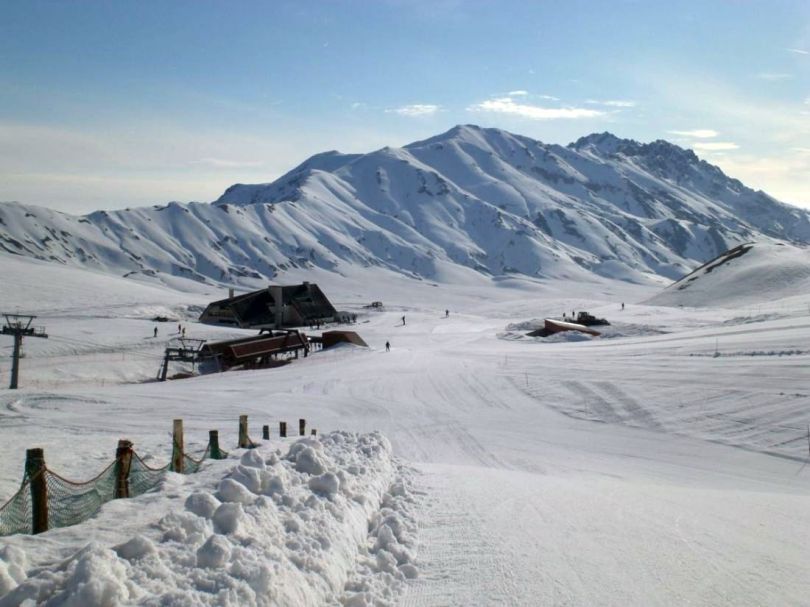
Alcuni giorni fa, quasi per caso, sono passato per Campo Felice, stazione sciistica intorno ai 2000 m s.l.m. che si trova nel territorio del Monte Velino, appena fuori L’Aquila. Campo Felice, da sempre promossa con lo slogan “un mare di sole e di neve”, è un luogo amato anche dai romani, dato che in poco più di un’ora di automobile dalla capitale ci si trova su piste che, pur non essendo all’altezza di quelle alpine, offrono un debito svago sciistico.
The sequence I’m about to show comes from one of the spin-off movies of the Harry Potter saga. I’m not a big fan of Harry Potter, but in this case, I feel there is something worth observing.
Ever since when I first watched this film, I have had the feeling that this gigantic, ominous and dark CGI creature can be a useful visual metaphor to conceptualize the spatial dynamics of affect. Emotions, as is today broadly understood across various fields of knowledge, are not the private, inner affairs of subjects, but rather spatialized forces that can “jump” from one subject to the other, capturing them and influencing their individual affective states. While they do “extend” into the ambient environment, emotions lack a precise geometrical definition, as the Harry Potter monster quite strikingly shows us. The spatial nature of emotions is not restricted to “destructive” affects such as hate or fear, but the purely incidental quality of this monster, its reckless violence and uncontrollability, creates an interesting conceptual bridge to the strong affective resonance we may encounter and experience in protests. We are observing something that resembles, albeit in a metaphorical way, that equally strange “creature” that was Sigfried Kracauer’s “revolting mass,” as he often encountered in the streets of Berlin in the years that would lead up to the rise of Nazism.1 In this short presentation, I will thus address three distinct issues: firstly, I will review some of the many theories postulating the externality of emotions, plotting how this spatial dimension unfolds within the urban environment; secondly, I will clarify how protest, as a specific urban practice, fully harnesses this spatial dimension to sustain its deployment; finally, I will discuss how a form of landscape – something akin to what has been so far here thematized as a landscape of protest – represents an emergent condition that is fueled by the interplay between urban space and human action.


 Questions on Architecture