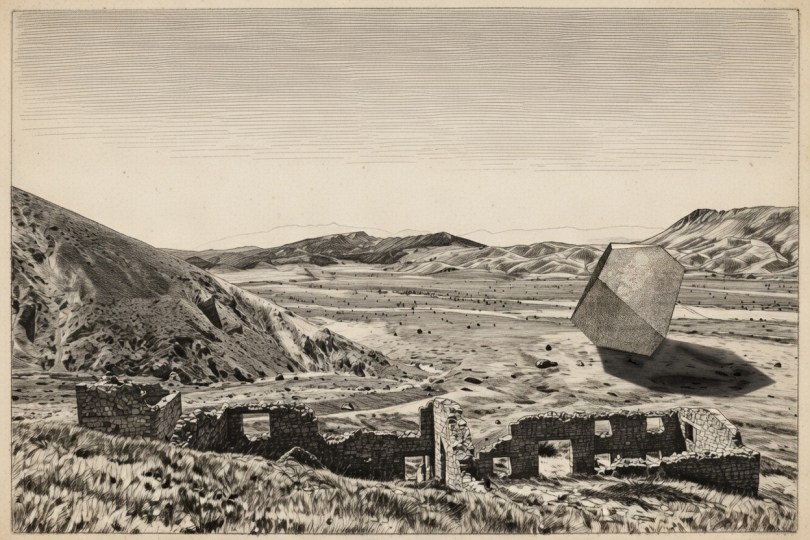
Among the many possible definitions of affective, I refer here, following Hermann Schmitz’s approach, to the complex of dynamics that animate the felt body, including atmospheric forces such as spatially effused feelings and embodied movements as they are perceived by the subject without resorting to distal senses. It is therefore a broad spectrum, which includes but is not limited to emotions understood as instruments of response and adaptation of the organism to the environment, thus also considering what the subject shares with other bodies and subjects that occupy the same experiential space. Affective, therefore, are the relationships that are established between two or more bodies through resonance, whether these are collaborative or antagonistic: topologically articulated relationships, changing over time, both culturally and corporeally declined. On the contrary, the mere connection with the landscape established by the dynamics of dwelling is not to be understood as affective, at least not according to the definition proposed here: this is a more complex fact, based on affective dynamics of resonance, but comprising a broader canvas, composed of cultural and political threads.
The relevance of the affective dimension in the dynamics of undwelling is relatively simple to describe. To dwell, according to Schmitz’s definition, consists in the ‘cultivation’ of feelings, or rather in a conscious filtering operation, aimed at excluding unwanted atmospheres capable of producing the contraction of the felt body. Schmitz indicates that the act of dwelling is primarily inherent to enclosed space – the interior of a building, or of an enclosure – but this does not exclude the possibility that the territory itself is the environment that is dwelt in. In any case, Schmitz’s definition speaks of a regressive dynamic, which limits the subject to an emotionally protective shell, denying their exposure to the outside world in a sort of fuga mundi. In undwelling, on the contrary, this dynamic is reversed: the action is defined in the first place by the opening of boundaries, whether material or not, to allow the entry of a wider range of affective agents, who ferry the subject beyond the safe harbor of the delimited space, protected by walls and fences. What this means for affective resonance is its liberation from the multiplicity of constraints deriving from the anchoring action of human presence on the territory, where only certain affective agents are normally admitted.
We cannot provide a univocal assessment of this expansion of affective dynamics, as the disposition of individuals or communities may attribute diametrically opposed values and meanings to these affects. However, we can observe that dwelling, according to Heidegger’s early interpretation is normally linked to controversial identity issues, to nostalgic polarizations of an extinct and idyllically idealized world, more generally to regressive political and cultural precedents, as well as to a stubborn attachment to monotheistic religious models and capitalist economic structures based solely on the idea of infinite growth. The action of undwelling, on the contrary, does not have a clear cultural orientation, as it aims to welcome a wider range of affective agents, even those that dwelling wishes to marginalize. For example, nostalgia – in my opinion one of the primary drivers of dwelling – is not necessarily banned from the dynamics of undwelling: on the contrary, it can manifest itself, but not exclusively in a regressive-conservative guise, but also accompanied by an activating bodily resonance.
Dwelling and undwelling, as near-polar opposites, both aim at a modulation of affects, often without a precise aesthetic agenda. It is interesting to note, however, that the actions of transformation of the territory linked to these diverging existential dynamics are not so distant. If we consider, for example, the drawing of a boundary – be it the erection of a perimeter wall around a building, a fence around a plot of land, or the border between two nations – in dwelling, the gesture is always intended to keep something or someone out, such as a stranger, an invader, or a hostile atmosphere. In undwelling, on the contrary, the drawing of a boundary serves to mark an exclusion not of another, but of ourselves: we delimit a territory that we no longer intend to care for because we do not have the resources to do so, or because for certain reasons – such as a natural or man-made disaster – it has in fact become uninhabitable. Those who dwell, therefore, keep at bay the affects that modulate the felt body in a contractive way; those who undwell allow them to exist, to prowl freely through space, but take a step back from the forbidden territory where this liberation of affects takes place, creating a sort of reserve for threatening daimons.
Similarly, we can consider the act of demolition in two distinctly different ways: in dwelling, demolition is a prerequisite for construction, as it removes from the terrain what has been achieved previously and is no longer useful – no longer useful, to be precise, either on a pragmatic or a symbolic-aesthetic level – to make room for a new foundation. Demolition is therefore a precursor to production, an archetypal action of government and control of the territory, producing activating affects, the quintessence of dwelling. In undwelling, demolition can remain an action without productive consequences, not oriented towards the repetition of acts of dwelling, but rather establishing a new condition that does not presume the subjugation of the land. In dwelling and undwelling, the operational tools are therefore the same, but they are used with opposite effects: one can walk forward or backward, both actions falling within the broader category of walking, but with completely different results, both in terms of motion and of affective resonance.
It is therefore clear that the transition from dwelling to undwelling involves not so much or not only design practices, but rather a cultural and, even more so, affective repositioning that transcends modern development models, which have by now proved inadequate to describe the future projections of aging territories. The Stimmung (base affective tone) of the modern Western world, although impossible to encapsulate in a single constant chord, has never been, nor is today, completely free from the impulses dictated by the desire to subjugate territories and colonize places, people, and communities. This is perhaps the leitmotif of capitalist development, of which the historical material expansion on the planet and beyond is both a cause and a direct consequence, in a procyclical succession of tensions. The affective dimension of this process is so deeply ingrained in our cultural and economic models that not only is the recessive movement of undwelling considered a defeat, but even an unrealistic, unnatural practice, a real contradiction. Movement, it seems, can only be forward, toward a future that is as distant as it is unattainable. A possible movement in the opposite direction – the retreat from already inhabited territories, with the various transformative tools that could be put in place – would lead to the emergence of intolerable, unacceptable, almost obscene emotions, camouflaged, if anything, by the superficial political rhetoric of optimistic development for all.
Undwelling, therefore, is not technically impossible; it does not require tools and practices that are unknown or untested. Its dimension of friction with reality consists precisely in bringing about affects that are inadmissible to modern Western culture. An uninhabited territory is considered – erroneously – to be entirely equivalent to an abandoned territory. Yet there is a substantial difference: an abandoned territory is a discarded territory, left to drift without care, like a ship that has lost its sails.
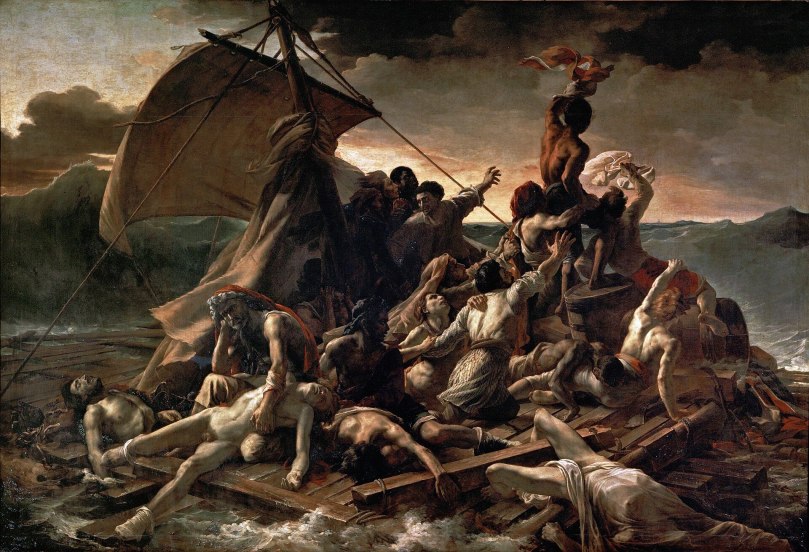
It is an image of unredeemable tragedy, evoking shipwrecks and sinkings, a raft of the Medusa of the magnificent destinies announced by progress. It is difficult to mourn this loss, because it appears to be irreversible, never to be the same again. An uninhabited territory (without confusing the purely quantitative meaning with the qualitative one, of course), on the contrary, is cared for, prepared to be left fallow.
The horror or disgust of abandonment in this case is replaced by less aggressive feelings, such as the nostalgic melancholy of autumn twilight, tempered by the confidence dictated by the protection of an asset for a future that, not being within our reach, may perhaps take different and less destructive paths than what has happened so far.
What we may come to expect from this “letting go”, from espousing the land’s twilight, is a future, be it near or far, where our fallow traces become part of something else: of a hybrid that we have not deliberately meant to be, of a world that affords us new distant panoramas, smells and sounds that we have never foreseen. And while it is likely that we will not be there to experience them, it is nevertheless likely that only through undwelling it will be possible to finally turn this world into a garden. Let us remember that, in ancient Persian, the word for a walled garden was pairi-daeza, an enclosure set apart from the desertic terror of the high Iranian plateau, lush with trees and flowers, bubbling with fresh water in the heat. To undwell, on the long term, might mean to set up the enclosure of a future paradise. Dwelling becomes undwelling when build the enclosed garden, but then stay outside.
The transition from dwelling to undwelling, or rather the possibility of solidly introducing undwelling into the practices of governing territories by now beyond repair, therefore requires an affective redefinition capable of tolerating the melancholy of “letting go” by putting things to rest, almost a different technique du corps for coping with the feelings generated by the atmosphere of twilight. It is not simply a matter of reversing the narrative, trying to convince ourselves and others that there is no real alternative to undwelling, and that anyone who proposes solutions and interventions for reinhabiting is motivated either by naivety or dishonesty. Rather, it is necessary to build an ‘affective scaffolding’, implementing practices of environmental manipulation that make the threatening affects that emerge from an uninhabited territory tolerable.
In order to undwell, it is not necessary to learn or develop new design techniques, nor simply to turn them into negatives. On the contrary, it is necessary to act on our perception of time, of time that is always unredeemable, on the culture that has led it to stretch out into an unbearable linear tension, until we recognize – once again, as it has always been – its cyclical nature, its breath that expands and contracts: the collective breath of a living world of which we are an organic part.
 Questions on Architecture